The Ultimate Powerlifting Belt Sizing Guide: Stop Measuring Like You Buy Jeans!
How to measure correctly, which Amazon brands run small, and exactly what to do before you click Buy Now.
Section 1: The ‘Jeans Size’ Trap — Why Your Pant Size Will Fail You
Here is how it goes. A new lifter decides to buy their first lifting belt. They check their jeans — size 34 — and order a Medium on Amazon. The belt arrives. It fits loosely around the waist with room to spare, or worse, it barely buckles. Either way, it is useless for generating real intra-abdominal pressure.
This happens every single day. And it is not the lifter’s fault — it is a misunderstanding of how clothing sizing works versus how performance equipment sizing works.
The Vanity Sizing Problem
Clothing manufacturers have been engaged in ‘vanity sizing’ for decades. That size 34 jean you are wearing? In many brands, the actual waist measurement is 36, 37, or even 38 inches. Brands do this intentionally — people feel better buying a smaller-sounding size, so they stay loyal to the brand.
A lifting belt does not care about your feelings. It is a precision support tool measured in actual inches against your actual body. When you order based on your jeans size, you are inserting a systematic error of 2 to 4 inches before you even click purchase.
Related: IBRO vs. Gymreapers: Is the Amazon Best-Seller Better Than the Pro Brand?
The second trap is where people measure — more on that in the next section. For now, understand this fundamental rule:
Your jeans size is not your belt size. It has never been your belt size. Measure your body — not your clothing label.
🏋️ COACH’S TIP: I have seen this mistake at every level — from beginners to intermediate lifters who have been training for years. Always take a fresh measurement before every belt purchase, even if you think you know your size. Body composition changes. Sizing charts differ between brands.
Section 2: Where to Measure — This Is Non-Negotiable
The single most important variable in belt sizing is measurement location. Get this wrong and every other step is meaningless.
The Navel Rule
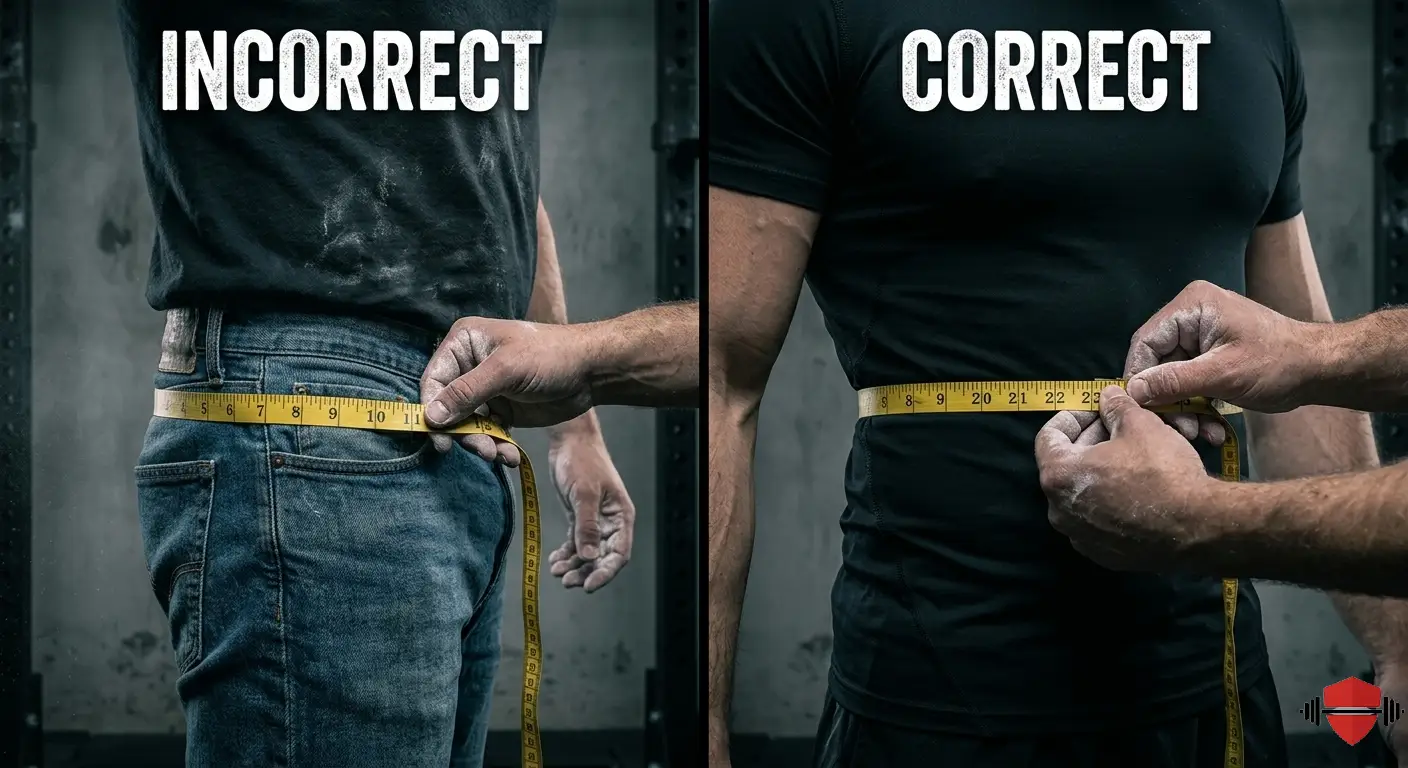
A powerlifting belt sits at your navel — your belly button — not at your hips where your jeans sit, and not at the narrowest point of your torso.
Most people measure their “waist” at the narrowest point (typically 2–3 inches above the navel). Some measure at the hip. Both are wrong for a lifting belt. The belt sits at navel level because that is where it applies pressure to your core during a brace — over the diaphragm and abdominals, not below them.
Step-by-Step Measurement Instructions
- Stand upright with your feet shoulder-width apart. Relax your posture — do not stand at military attention, and do not slouch.
- Locate your navel (belly button). This is your measurement point. Wrap the tape around your body at exactly this level — not above, not below.
- Keep the tape parallel to the floor all the way around. A tape that dips in the back will give you a falsely small measurement.
- Do not suck in your stomach. You are not trying to get a small number — you are trying to get an accurate one. A belt that fits a sucked-in stomach offers no real support when you brace.
- Do not puff your stomach out aggressively either. Stand in a natural, relaxed stance.
- Read the measurement where the tape meets. Record it in inches. This is your working measurement.
📏 HOW TO: Measure three times and take the average. Tape tension, posture micro-variations, and tape positioning can cause slight differences. Three measurements averaged to the nearest half-inch gives you a reliable figure to work from.
Section 3: The Tension Factor — How Tight to Pull the Tape
Tape tension is where experienced coaches see the next wave of sizing errors. There are two common mistakes:
- Measuring with a loose tape — this gives you a measurement that is 1–2 inches too large, resulting in a belt that is too big
- Measuring with an aggressively tight tape — this simulates a belt pulled tighter than you would ever actually wear it
The correct approach: pull the tape snug against the skin, with zero slack, but without compressing the soft tissue. Imagine the tape is resting against the skin with gentle, even pressure — like a belt at its working tension during a set.
The ‘Braced’ Measurement (Advanced)
For athletes who want precision: take a second measurement while performing a light brace — tighten your core as if you are about to squat, but at roughly 60–70% tension. Do not hold your breath; just create mild intra-abdominal pressure.
This “braced” measurement will be 1–3 inches larger than your relaxed measurement, depending on your core development. For a belt that will be used at competition-level tightness, purchasing based on the braced measurement can ensure you have room to perform a full brace without the belt becoming a limiting factor.
🏋️ COACH’S TIP: My recommendation for most athletes: use the relaxed measurement to select your size, then ensure that measurement falls in the MIDDLE of the selected size’s range. This naturally builds in the buffer you need for bracing without over-sizing.
Section 4: Tools — The Tailor’s Tape vs. The String Method
Option A: Tailor’s Flexible Tape Measure (Preferred)
A flexible tailor’s tape — the kind used in sewing — is the ideal tool. It costs less than two dollars on Amazon or at any craft store. It conforms to the body, lies flat, and gives a direct readout in inches. Every serious athlete should own one. Keep it in your gym bag.
- Cost: Under $2
- Accuracy: High, when used correctly
- Availability: Any Amazon search for ‘tailor’s tape measure’ will return dozens of options
- Use case: Measuring for any soft goods — belts, knee sleeves, singlets
Option B: The String and Ruler Method
No tailor’s tape available? Use a length of string, a shoelace, or any non-elastic cord.
- Wrap the string around your navel, following all the same rules as above.
- Pinch the string at the point where it meets itself. Mark that point with a pen, or hold it carefully.
- Lay the string flat against a rigid ruler or against the floor next to a tape measure.
- Read the measurement in inches.
⚠️ WARNING: Never use an elastic hair tie, a stretchy cord, or an elastic fabric strip as your measuring tool. Any stretch in the measuring material gives you a false reading. Use a non-elastic string only.
Section 5: Amazon Brand Comparison — Sizing Case Studies
Not all sizing charts are created equal. Here is what you actually need to know about the most popular powerlifting belt brands available on Amazon right now.
| Brand | Belt Type | Sizes | Waist Range (inches) | Key Notes |
| Iron Bull Strength | 10mm Prong | S–XXXL | 26″–52″+ | Generous sizing; measure true waist, size down if borderline |
| Iron Bull Strength | 13mm Lever | S–XXL | 28″–46″ | Lever version — measure precisely; no field adjustment |
| Gymreapers | Quick-Release Prong | S–XXXL | 25″–50″+ | Runs slightly small; go up one size if borderline |
| Gymreapers | 10mm Lever | S–XXL | 28″–44″ | Narrower range; confirm your measurement sits in the MID-RANGE |
| Hawk Sports | 10mm Prong | S–XXL | 24″–46″ | Economy tier; sizing inconsistency between batches reported |
| Rogue Ohio | 13mm Prong | S–3XL | 26″–52″ | Premium consistency; follow chart exactly — no need to adjust |
| SBD (IPF Approved) | 13mm Lever | XS–XL | 26″–42″ | Most precise fit system; half-sizes available; measure at full brace |
Iron Bull Strength: Deep Dive
Iron Bull Strength is one of the most popular entry-to-intermediate belt brands on Amazon. Their 10mm prong belt is a strong value option for beginners. Their sizing is generally accurate but on the generous side — if your measurement falls right at the top of a size range, consider staying in that size rather than moving up.
Their 13mm lever belt is the consideration point. Lever belts allow only one fixed closure position. Iron Bull’s lever belt has a slightly narrower size window per size than their prong models. Athletes who are between sizes on the 13mm lever should size down and use the lever adjustment to find the correct hole position, rather than sizing up.
Gymreapers: Deep Dive
Gymreapers has built a significant following on Amazon, particularly for their Quick-Release lever belt mechanism. User reviews consistently note that Gymreapers belts run slightly small — meaning a measurement that falls at the bottom of a size range on their chart will likely fit correctly, but a measurement at the top of a range may feel uncomfortably tight.
Their lever belt has a narrower waist range per size than the prong model. This is the belt where precision matters most in the Gymreapers lineup.
Hawk Sports: A Note on Economy Tier Consistency
Budget belts in the Hawk Sports category can offer acceptable value for recreational lifters. However, sizing consistency is a real concern at this price point. User reviews frequently note variation between batches — the same size ordered in different shipments can differ by 0.5–1 inch in actual dimension. If purchasing from this tier, check the most recent reviews specifically for sizing comments, and prioritize sellers with clear return policies.
Rogue and SBD: The Premium Standard
Rogue Ohio belts and SBD belts represent the premium tier. Both brands have invested significantly in sizing precision and quality control. If you follow their measurement instructions and land in their charts correctly, you will get a consistent, accurate fit. SBD in particular offers a detailed half-size system and instructs athletes to measure at full brace — follow their specific instructions rather than general guidelines.
🏋️ COACH’S TIP: When reading Amazon reviews for belt sizing, filter specifically for reviews that mention ‘sizing,’ ‘fit,’ or ‘size.’ These give you real-world feedback that sizing charts alone cannot provide. Look at the most recent 30–50 reviews to catch any recent batch issues.
Section 6: The Mid-Range Rule — Your Sizing Safety Net
This is the single most practical piece of sizing advice I give every athlete.
Always choose the size where your measurement falls closest to the middle of the range — not at the very top or bottom edge.
Why the Middle Matters
- Body weight fluctuates. Athletes cutting weight for a meet can lose 5–10 lbs of water weight. A belt sized at the very bottom of the range may become uncomfortably loose after a cut.
- Strength athletes in offseason often add body mass. A belt sized at the very top of a range may become too tight within a training cycle.
- The middle of the range gives you 1–2 inches of adjustment in either direction — accommodating both scenarios without needing to replace the belt.
Example
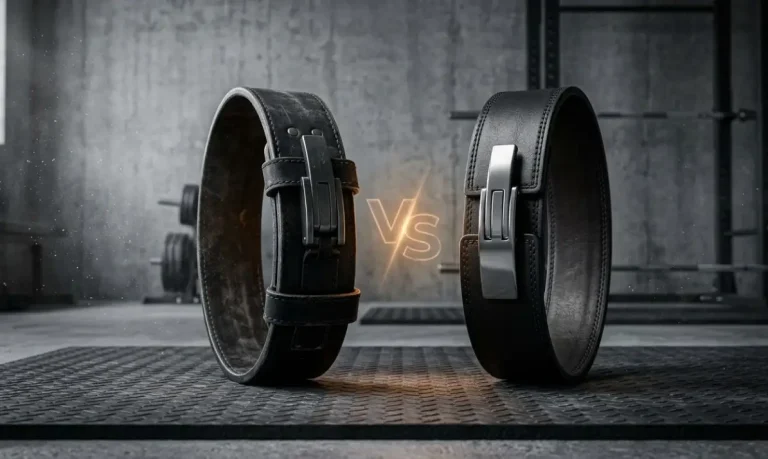
Imagine a brand’s Medium covers 32″–36″ and Large covers 36″–40″. You measure at 35″. On paper, you are in the Medium. But 35″ is at the very top of the Medium range.
In this case: check where 35″ falls in the Large range. If the Large prong belt has multiple holes, 35″ in a Large gives you room to tighten significantly if you cut weight, and room to loosen if you add mass. For a prong belt, this can be the better choice. For a lever belt, you would want to stay in the Medium since you need to be mid-range for the single-position closure.
✅ RULE OF THUMB: If your measurement falls in the top 15% of a size range for a lever belt, consider sizing down. If it falls in the bottom 15%, consider sizing up. You want to be in the comfortable middle third.
Section 7: Prong vs. Lever Belt Sizing — Why It Changes Everything
The type of closure mechanism you choose has a direct impact on how strictly you need to follow the sizing guide. This is not a minor consideration — it changes the consequences of getting it wrong.
| Prong Belt | Lever Belt | |
| Sizing Forgiveness | High — multiple holes give ~3″ of adjustment | Low — one fixed position; wrong size = wrong belt |
| In-Session Adjustment | Easy — change hole position anytime | Requires a small flathead screwdriver |
| Best For | Beginners, athletes in weight-cut cycles, body composition changes | Experienced lifters with a stable, confirmed measurement |
| Measure Accuracy Needed | ±1–2 inches is acceptable | Must be within ±0.5 inches for correct fit |
| If You Measure Wrong | Move to adjacent hole | Must return and exchange the belt |
| Amazon Recommendation | Gymreapers Quick-Release, Iron Bull 10mm Prong | Iron Bull 13mm Lever (size down if between sizes) |
The Lever Belt Screwdriver Reality
When athletes find out that adjusting a lever belt requires a screwdriver, they often assume this means once, at setup. In reality, if you are cutting weight for a meet, your waist measurement can drop 1–3 inches. A lever belt that was perfectly positioned at your off-season measurement may now be one or two holes off. You will need to unscrew the lever plate, reposition it, and re-drill (or have an equipment tech do it) to re-fit the belt.
This is not a dealbreaker — lever belts are faster and more consistent to put on during competition. But it means your initial measurement must be accurate, and you should not expect to make casual adjustments the way you would with a prong belt.
🏋️ COACH’S TIP: If you are new to competitive powerlifting and your body weight is still changing significantly — whether you are gaining muscle in a building phase or cutting for meets — start with a prong belt. The flexibility to adjust by a hole is worth more than the speed of a lever when your size is still in flux. Once you are within 5 lbs of a stable competition weight, consider transitioning to a lever.
Section 8: The Final Checklist — Before You Hit ‘Buy Now’
Print this. Screenshot it. Write it on your hand. Whatever it takes — run through every item before you complete your Amazon purchase.
| Pre-Purchase Checklist Item | Done? | |
| ☐ | I measured at my navel (belly button level) — NOT at my hips or where my jeans sit | |
| ☐ | I used a flexible tailor’s tape (or the string + ruler method) — not a rigid measuring tape | |
| ☐ | I measured while standing with a neutral stomach — not fully flexed, not sucked in | |
| ☐ | My measurement falls in the MID-RANGE of the size I’m selecting (not at the very edge) | |
| ☐ | I have confirmed whether I’m buying a prong or lever belt and understand the adjustment differences | |
| ☐ | I checked the specific brand’s sizing chart on their Amazon listing — not a generic size guide | |
| ☐ | If buying a lever belt, I am confident in my measurement to within ±0.5 inches | |
| ☐ | I have read recent Amazon reviews mentioning sizing to catch batch inconsistencies | |
| ☐ | I understand the return policy before purchasing in case the fit is wrong |
If you can check every box on that list, you are in the best possible position to receive a belt that fits correctly, provides real support, and serves you for years of training.
If you are unsure about any item — particularly the mid-range check on a lever belt — stop. Re-measure. Check the brand’s chart again. A $60–$150 belt that does not fit is money wasted. Five extra minutes of measurement is free.
Measure right. Size smart. Pull heavy.
Disclaimer: Sizing information for specific brands is based on publicly available charts and user reports. Always verify directly against the brand’s current Amazon listing before purchasing, as sizing charts are updated periodically. Brand names are referenced for informational purposes only.
Sources for this article:
- IPF Rules and Equipment:
International Powerlifting Federation. Technical Rulebook. powerlifting.sport/index.php/results/technical-rules
IPF Approved Equipment List (2023–2026). powerlifting.sport/index.php/equipment/approved-list
2. Neoprene and Materials Science:
Harper, N.G., et al. “Effect of a Knee Brace on Patellofemoral Joint Loading.” Journal of Orthopaedic and Sports Physical Therapy, 2014.
Sinclair, J., et al. “Effect of a Knee Brace on Knee Biomechanics During the Squat.” Journal of Human Kinetics, 2016.
3. Belt and Intra-Abdominal Pressure:
McGill, S.M. Low Back Disorders: Evidence-Based Prevention and Rehabilitation. 3rd ed. Human Kinetics, 2015.
Harman, E. A., et al., “Intra-Abdominal and Intra-Thoracic Pressures During Weightlifting and Jumping.” Medicine & Science in Sports & Exercise, 1988.
Lander, J. E., et al., “Effectiveness of Weighted Belts during Squats.” Medicine & Science in Sports & Exercise, 1990.
4. Clothing Sizing:
Workman, J. E., and Lenz, E. S., “Technical Characteristics and Sizing of Clothing.” Clothing and Textiles Research Journal, 2000.
Piacentini, M., and Mailer, G., “Symbolic Consumption in Adolescents.” Journal of Consumer Behavior, 2004.