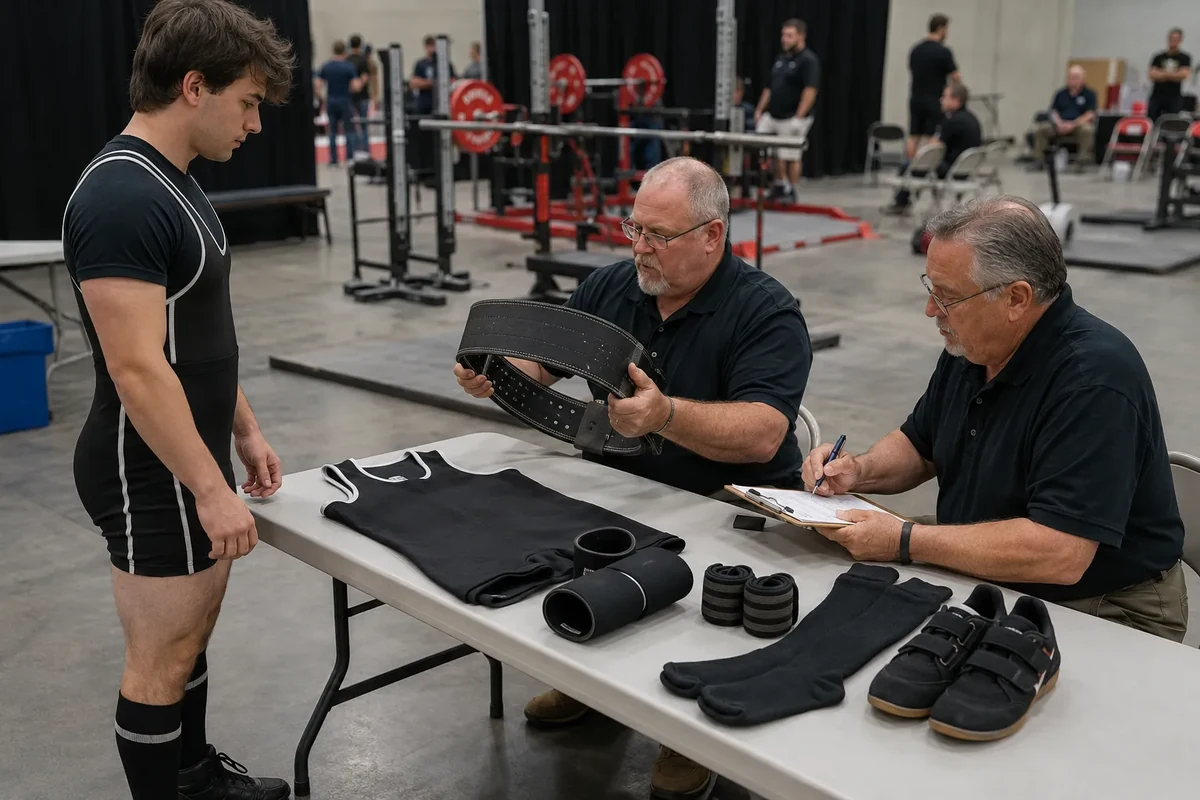
IPF Equipment Inspection 2026: What Referees Actually Check
Equipment inspection sounds more intimidating than it usually is.
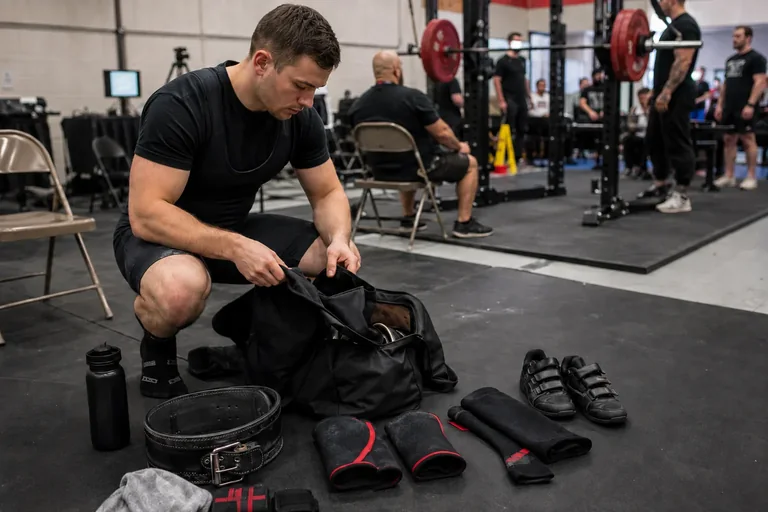
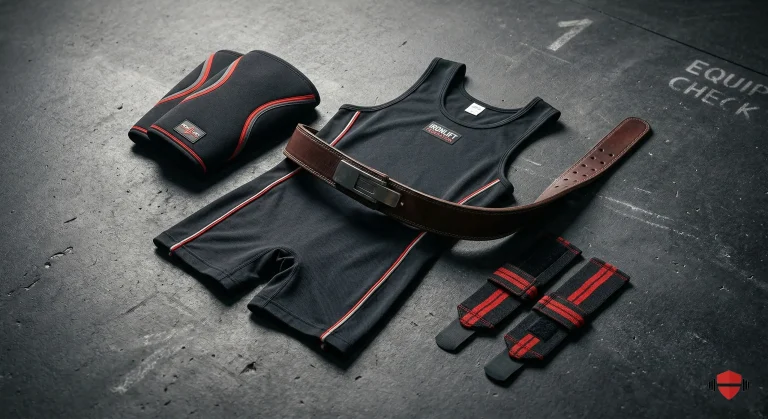
You walk into your first IPF meet with a singlet, belt, knee sleeves, wrist wraps, shoes and a bag full of things you've spent too much time thinking about.
Then somebody says:
“Gear check.”
And suddenly you start wondering whether the referees are about to measure every stitch in your singlet with laboratory equipment.
They're not.
But they are checking something important.
Equipment inspection is where officials confirm that the clothing and supportive gear you intend to use on the platform complies with the current rules.
For most lifters who prepared properly, it is quick and uneventful.
The problems usually happen when someone brings the wrong product, assumes “IPF approved brand” means every item from that company is legal, uses wraps outside the permitted dimensions, or shows up with equipment in poor condition.
Here's what actually happens — and what you should check before you leave home.
Table of Contents
What Is IPF Equipment Inspection?
The rulebook calls it inspection of personal equipment.
It is a formal check of the personal gear a lifter plans to use during competition.
Under the current 2026 IPF Technical Rulebook, a minimum of two referees are appointed for the inspection.
Items are examined and approved before being officially marked or recorded as accepted for use.
The important word here is:
items.
This is not simply somebody asking:
“Are your knee sleeves SBD?”
and waving you through.
The referee is checking whether the equipment you actually brought fits the current rules.
When Does Equipment Inspection Happen?
Do not assume gear check happens at exactly the same time at every meet.
The Technical Rulebook allows inspection to take place at announced times throughout the competition schedule, with the timing arranged before the final period leading into the lifter's bodyweight category.
At a local meet, the organizer may make this very simple.
You check in.
You weigh in.
You move to another table.
Someone checks your equipment.
At a larger championship, the process can be more structured.
The meet information or Technical Meeting should tell you when and where inspection is happening.
Read that information before arriving.
The best equipment inspection is the one you do not have to sprint across a venue to find.
What Should You Bring to Gear Check?
Bring the equipment you actually intend to use on the platform.
Do not bring one belt for inspection and then decide to compete in another one you left in the warm-up room.
For a typical Classic lifter, that can include:
- competition singlet;
- T-shirt;
- belt;
- knee sleeves;
- wrist wraps;
- socks;
- competition footwear;
- any other personal equipment covered by the rules.
If you're competing Equipped, the list can also include supportive suits, supportive shirts and knee wraps as applicable.
The safest rule is simple:
If you plan to wear it while lifting and the rulebook treats it as personal equipment, have it checked.
What Referees Are Actually Looking For
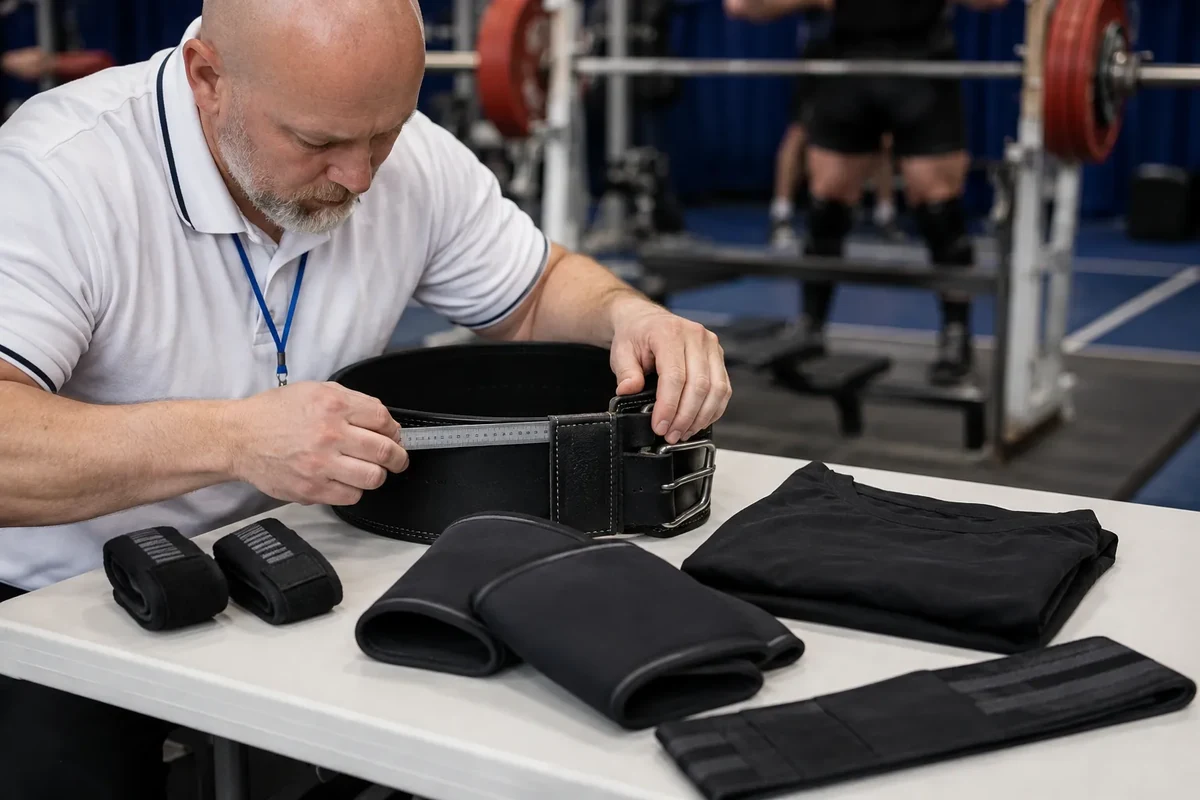
There isn't one single question.
They are checking several different things at once.
Is the Item Allowed at All?
Some equipment is permitted only in a particular division.
Knee wraps are the obvious example.
They are Equipped equipment.
Showing up to a Classic meet with legal two-meter knee wraps does not make them Classic equipment.
The item may satisfy its own dimensional limits and still be wrong for your division.
Does the Item Need IPF Approval?
This distinction causes a lot of confusion.
Certain equipment is tied to the IPF Approved List.
That includes items such as approved singlets, supportive suits, supportive shirts, belts, knee sleeves and supportive wraps.
Other clothing categories are primarily checked against their technical specifications rather than being treated exactly the same way as an approved belt or sleeve.
That is why checking the exact product before your meet matters.
Do not reduce the process to:
“My brand is approved.”
The official list identifies equipment, not your loyalty to a logo.
Does It Meet the Technical Specifications?
Approval is not a free pass around the rulebook.
An approved type of equipment still has to comply with the technical requirements.
A knee sleeve still has thickness and length limits.
A wrist wrap still has length and width limits.
A belt still has dimensional limits.
So inspection can involve both questions:
Is this an accepted product?
and
Is this being presented in a form that complies with the rules?
Singlet Inspection
For Classic competition, the non-supportive singlet is one of the obvious pieces of equipment to check.
The current rules require the singlet to be form-fitting and non-supportive.
The shoulder straps are worn over the shoulders during all lifts.
For standard singlets, leg length is regulated.
The rules also now account for approved long-legged singlets, which have their own interaction with knee sleeves and socks.
One detail worth knowing: whichever permitted singlet type you use for the squat is the one you continue using through the disciplines.
This is not the ideal time to bring three singlets and treat gear check like a fitting room.
Know which one you're competing in.
T-Shirt Inspection
The current 2026 IPF rules require a T-shirt under the singlet for the squat, bench press and deadlift, except where an Equipped supportive shirt is permitted instead.
A normal competition T-shirt has its own construction requirements.
Officials can care about:
- material;
- fit;
- sleeve length;
- reinforced or supportive construction;
- logos.
The shirt should not have rubberized supportive material, reinforced seams, pockets, buttons or zippers.
Its sleeves must fit properly and remain within the permitted area of the upper arm.
For a first meet, a simple compliant shirt removes a remarkable number of unnecessary questions.
Underwear
Nobody is trying to make equipment inspection awkward.
But what you wear under the singlet is still regulated.
The current IPF rules allow standard commercial briefs or an athletic supporter made from the permitted normal materials.
Women may also wear a commercial or sports bra.
Supportive underwear is not permitted.
Rubberized or similar supportive garments are not something you should try to hide underneath the singlet.
If you're wondering whether your compression shorts are “probably fine because nobody can see them,” that is the wrong way to prepare for a rules-based competition.
Use straightforward compliant underwear.
Then forget about it.
The Belt
The belt is one of the easiest items to verify before meet day.
For IPF competition, the belt must come from an accepted manufacturer under the current approval system.
It is worn outside the lifting suit or singlet.
The major dimensional limits include:
- maximum width: 10 cm
- maximum thickness: 13 mm
The rulebook also regulates the buckle and tongue-loop dimensions.
One-prong, two-prong and lever-style systems are permitted when the belt otherwise complies.
Referees are not checking whether you wear the belt high or low on your stomach.
They are checking the belt itself and whether it complies with the rules.
Your preferred placement is a technique question.
The construction is a competition question.
Shoes and Deadlift Slippers
Competition footwear is often misunderstood because lifters search for an “IPF Approved shoe list” as though shoes work exactly like belts.
They don't.
The Technical Rulebook defines the permitted footwear category and technical limits.
Current rules allow appropriate indoor sports shoes or boots, weightlifting/powerlifting shoes and deadlift slippers.
The sole thickness may not exceed 5 cm at any point.
The underside needs to be flat, without prohibited projections or modifications.
And when you step onto the platform, the shoes need to be properly fastened.
That means tied laces or secured Velcro where applicable.
The referee isn't interested in how expensive your shoes were.
They are interested in whether the shoes satisfy the rules.
Knee Sleeves
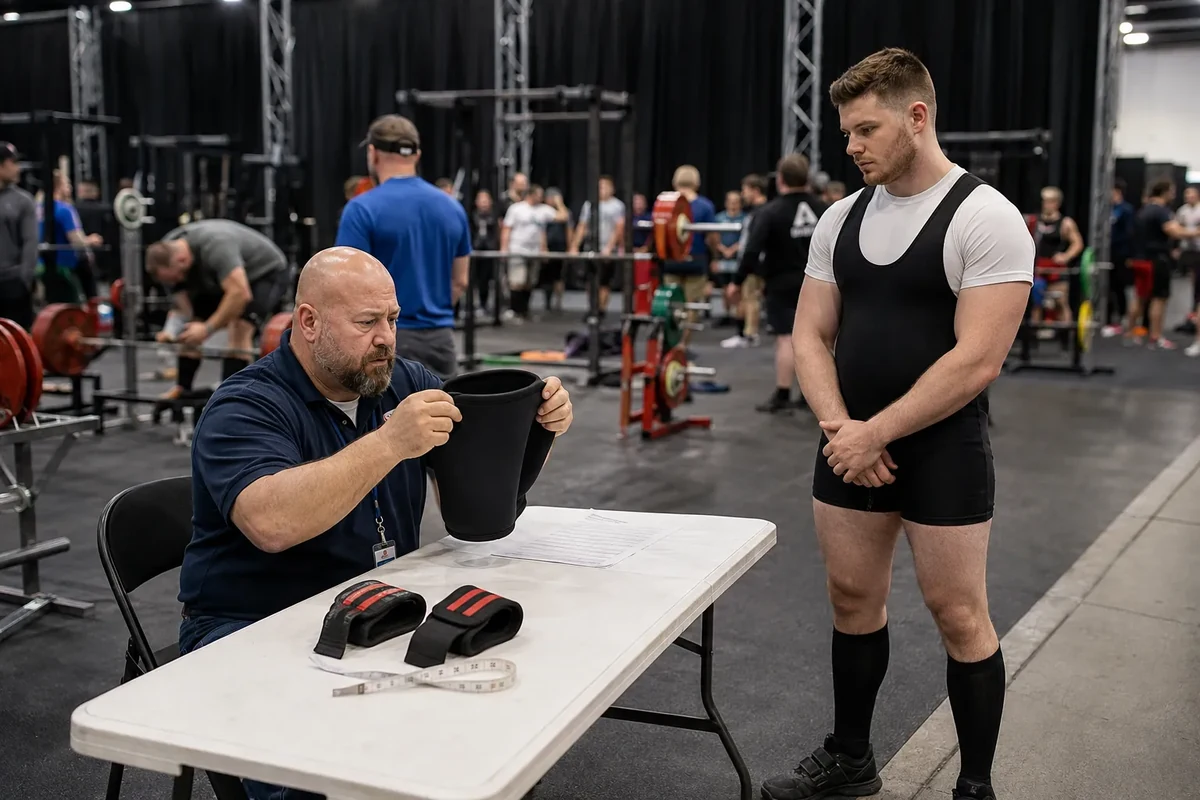
Knee sleeves get a lot of attention because competition-fit sleeves can be extremely tight.
Under the current rules, sleeves are limited to:
- 7 mm maximum thickness
- 30 cm maximum length
They must be continuous neoprene cylinders without extra straps, Velcro, drawstrings, padding or similar added supportive devices.
When worn, they are centered over the knee.
Under the standard rule, they must not contact the singlet or socks in a prohibited way.
And knee sleeves cannot be combined with knee wraps.
Getting Tight Knee Sleeves On
This is one area where lifters should pay close attention to the current meet procedure.
The rules clearly prohibit using things such as lubricants or plastic sliding devices to get sleeves on.
Using socks as an aid is specifically permitted.
The 2026 rulebook also states in the knee-sleeve section that athletes may receive personal assistance in putting their sleeves on.
The inspection subsection contains awkward wording around assistance while also repeating that personal assistance is permitted.
Because of that wording, don't invent your own meet-day method.
Use the normal permitted technique you practiced, avoid lubricants and plastic devices, and follow the Technical Controller or referees if they give a specific instruction.
The easiest setup is still the one that does not require a construction project every time the sleeves go over your calves.
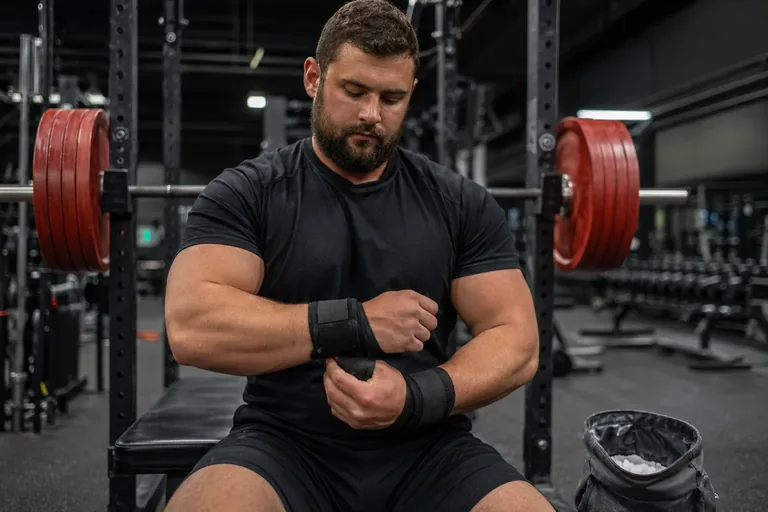
Wrist Wraps
Wrist wraps are another easy inspection item if you know the numbers.
Current IPF limits are:
- 1 m maximum length
- 8 cm maximum width
Any fastening sleeves and Velcro tabs count within that one-meter length.
A thumb loop may be used to help secure the wrap.
But the loop cannot remain over the thumb or fingers during the actual lift.
When worn, the wrap also has limits on how far it may extend above and below the center of the wrist joint.
One small detail people forget:
wrist wraps cannot be combined with sweat bands on the same wrist.
If you normally train with both, practice the competition setup before meet day.
Knee Wraps
For Equipped competition, knee wraps may be up to:
- 2 m long
- 8 cm wide
Their coverage around the knee is also limited.
They cannot contact the lifting suit or socks, and knee wraps cannot be combined with knee sleeves.
This is also where the rulebook gives lifters a useful bit of flexibility at inspection.
If wraps are longer than permitted, they are rejected — but the lifter may cut them down to the legal length and present them again.
So an over-length wrap does not automatically end your competition.
It means the wrap, in its current state, cannot be used.
What About Socks?
Socks have rules too.
For the deadlift, shin-length socks are required to cover and protect the shins.
Regular socks cannot be positioned so that they improperly contact knee wraps or knee-support equipment.
Full-length stockings, tights or hose are not permitted.
This is why a cheap spare pair of deadlift socks is one of the smartest things you can throw in the meet bag.
A backup pair takes almost no space.
Logos Can Matter
A perfectly normal piece of clothing can still create a problem if the logo does not comply.
IPF has separate rules for manufacturer, national, event, sponsor and other logos.
There are situations where logos from manufacturers not appearing on the Approved List or approved logo addendum may appear on T-shirts, shoes or socks only within specified dimensions.
For most first-time lifters, the easiest solution is not to become a competition-logo lawyer.
Wear simple clothing.
Avoid huge unapproved sponsor graphics.
If you've had something custom printed, check it before the meet.
The federation cares about what is on the clothing, not just the clothing itself.
Dirty or Torn Gear Can Be Rejected
This part of the rulebook is wonderfully uncomplicated.
An item considered unclean or torn can be rejected.
That means:
being an approved model does not give a destroyed piece of gear eternal competition immunity.
Before the meet, look at your equipment like somebody else is going to inspect it.
Because somebody else is.
Check the Velcro.
Check the seams.
Look for significant tears.
Make sure the singlet is clean.
Make sure the wraps aren't falling apart.
You do not need brand-new gear.
You do need gear that is in usable condition.
What Does Not Need to Be Inspected?
The rulebook specifically notes several personal items that do not need to go through the same inspection process.
Examples include:
- watches;
- costume jewelry;
- mouthpieces;
- eyewear;
- feminine hygiene articles.
That does not mean everything on that list can necessarily be worn however you want while performing a lift.
It means they are not treated as items that need the same formal personal-equipment inspection.
Keep gear check focused on the competition equipment that actually belongs there.
Rejected Gear Does Not Automatically Mean You're Disqualified
This is probably the most important thing for a first-time lifter to understand.
If an item fails equipment inspection, the item is rejected.
That is not automatically the same as the lifter being thrown out of the meet.
The obvious example is an over-length wrap.
It can be rejected, shortened and resubmitted.
If a shirt is wrong and you have a compliant spare, use the spare.
If a pair of wraps cannot be used, compete without them if the rules and division allow that.
Gear check exists partly to catch these problems before you step onto the platform.
That distinction matters.
When Can Illegal Equipment Become a Disqualification Problem?
Things become much more serious if you pass inspection and then appear on the platform using an illegal item that was not the equipment properly cleared for you.
The current rulebook provides for immediate disqualification when a lifter is found using illegal equipment after inspection, except for a different procedure where officials themselves inadvertently approved the illegal item.
The rules also place responsibility on the lifter to make sure everything they intend to wear on the platform has been inspected.
So do not play games with gear check.
Do not have one pair of sleeves inspected and then put on another pair because they feel tighter.
Do not hide an uninspected shirt under the singlet.
Do not assume nobody will notice.
Aside from the sporting issue, it's an incredibly silly way to lose months of meet preparation.
What If the Referees Accidentally Approved an Illegal Item?
The rulebook distinguishes this from a lifter deliberately using something that was not properly accepted.
If an illegal item was inadvertently passed by the examining referees and is later discovered during the competition, the successful lift where it is discovered can be rejected.
The lifter is then allowed a replacement attempt at the end of the round after removing the illegal item.
That is very different from intentionally appearing with equipment that never passed scrutiny.
The distinction is useful because it shows why equipment inspection is not simply ceremonial.
Officials are responsible for checking.
The lifter is responsible for presenting the correct equipment.
Can Referees Check You Again on the Platform?
Yes.
Passing equipment inspection does not make your clothing invisible for the rest of the day.
During the contest, referees are still responsible for making sure personal equipment complies.
If a referee has reason to suspect illegal equipment, the matter can be brought to the Chief Referee and Jury.
A Technical Controller may also scrutinize attire before the lifter is allowed onto the platform.
So equipment inspection is the first formal check.
It is not necessarily the last time anyone looks at your gear.
World Record Attempts Get an Extra Check
If you're attempting a world record, expect another layer of scrutiny.
Before the attempt, the lifter is inspected by the Technical Controller.
That makes sense.
A world record should not become official and then turn into a debate about whether the athlete was wearing prohibited equipment.
For most people reading a first-meet guide, this will not matter yet.
But it's useful context: the importance of equipment compliance goes up, not down, as the level of competition rises.
The Biggest Equipment Inspection Mistakes
Most gear-check failures are predictable.
“The Brand Is Approved”
That is not enough.
Check the exact item where product approval is required.
Buying Gear the Night Before
Even if it's legal, you have no idea whether it fits.
This is particularly bad with knee sleeves and singlets.
Bringing Only One Shirt
A simple backup competition shirt can solve an annoying problem immediately.
Using Damaged Wraps
If the Velcro is barely holding and the fabric is tearing apart, don't expect the referees to treat the wrap like a treasured family heirloom.
Forgetting Deadlift Socks
This remains one of the least glamorous ways to borrow clothing from another powerlifter.
Pack two pairs.
Assuming Equipment Inspection Is the Only Check
Your gear still has to be legal when you step onto the platform.
Using Something That Wasn't Inspected
Don't.
There is almost no upside and a large downside.
Do a Home Equipment Inspection First
A few days before your meet, spread everything out on the floor.
Now pretend you're the referee.
Singlet
Is it the exact one you're planning to compete in?
Is it compliant and in good condition?
T-Shirt
Correct construction?
Correct sleeves?
No questionable giant logos?
Belt
Correct approved item where required?
No structural damage?
Knee Sleeves
Correct model?
No tears?
Within the relevant dimensions and construction rules?
Wrist Wraps
Correct length and width?
Velcro still secure?
Socks
Deadlift pair packed?
No conflicts with knee equipment?
Shoes
Normal permitted footwear?
Flat compliant sole?
Laces and Velcro work?
Then put the entire setup in the meet bag.
This is much easier than finding one item at a time while somebody behind you is waiting for their gear check.
What I Would Bring as Backup
You do not need a duplicate of every expensive piece of equipment.
A spare lever belt is not exactly pocket-sized.
But inexpensive backups are worth considering.
For example:
- second compliant T-shirt;
- spare deadlift socks;
- spare underwear;
- alternate legal wrist wraps if you already own them;
- second singlet if you already have one.
The idea isn't to prepare for a wardrobe catastrophe.
It's to make small problems stay small.
Equipment Inspection Checklist
Before leaving for an IPF meet:
- Check the current IPF Technical Rulebook
- Check the current Approved List for equipment that requires approval
- Verify exact products, not just brands
- Bring the singlet you actually intend to use
- Bring a compliant competition T-shirt
- Check your belt condition
- Check knee sleeve seams and condition
- Confirm wrist wrap length and width
- Confirm knee wrap dimensions if competing Equipped
- Pack deadlift socks
- Check competition shoes
- Avoid questionable or oversized logos
- Do not use lubricants or plastic devices to put knee sleeves on
- Make sure everything is clean and usable
- Bring simple clothing backups where practical
- Follow the meet's announced gear-check time
If that list is done, inspection should be one of the least interesting parts of your meet.
That is exactly how you want it.
Frequently Asked Questions
What happens at IPF equipment inspection?
Referees examine the personal equipment you intend to use and confirm that it complies with current rules before it is officially accepted for competition.
How many referees inspect equipment?
The current IPF Technical Rulebook requires a minimum of two referees to be appointed for personal-equipment inspection.
Does every item I wear need to be IPF approved?
No.
Different categories work differently.
Certain competition equipment is tied to the Approved List, while other clothing such as standard T-shirts and footwear is governed primarily by technical and logo requirements.
What happens if my gear fails inspection?
The item is rejected and cannot be used in that condition.
That does not automatically mean the lifter is disqualified.
Some issues can be corrected — for example, over-length wraps may be shortened and resubmitted.
Can dirty equipment be rejected?
Yes.
The current rulebook says items considered unclean or torn may be rejected.
Can I cut wrist or knee wraps if they are too long?
The inspection rule allows wraps over the permitted length to be rejected, cut to the correct length and presented again.
Do referees inspect my shoes?
Shoes fall under the personal-equipment rules and must satisfy the current footwear requirements, including sole and fastening rules.
Do IPF shoes need to appear as an exact model on the Approved List?
Footwear is governed differently from approved belts, knee sleeves or supportive wraps.
The important check is whether the shoes fall within the permitted footwear category and meet the Technical Rulebook requirements.
Can I use lubricant to put on tight knee sleeves?
No.
The rulebook specifically identifies lubricants and plastic sliding devices as prohibited methods in connection with knee-sleeve application.
Can I use socks to put knee sleeves on?
Yes.
The current rules specifically permit socks as an aid when putting knee sleeves on.
Can somebody help me put on my knee sleeves?
The 2026 knee-sleeve section expressly states that athletes may receive personal assistance in applying their sleeves.
Because the inspection subsection contains awkward overlapping language on this point, follow the instructions of the Technical Controller or examining referees at your meet rather than using an improvised method.
Do I get disqualified if a referee rejects something at gear check?
No, not simply because an item is rejected during inspection.
Disqualification becomes relevant in situations such as appearing on the platform with illegal equipment after inspection, subject to the specific exceptions and procedures in the rulebook.
What if the referees accidentally approve something illegal?
If an illegal item was passed by officials in error and is later discovered, the current rules provide a separate procedure. A successful lift where the item is discovered can be rejected, and the lifter may receive another attempt at the end of the round after removing the illegal item.
Can equipment be checked again after inspection?
Yes.
Referees and Technical Controllers can still scrutinize personal equipment during the competition.
Is there another inspection before a world record attempt?
Yes.
Before a world record attempt, the lifter is inspected by the Technical Controller.
Gear Check Should Be Boring
You don't need to be nervous about equipment inspection.
You need to prepare for it.
Use gear that complies.
Check the exact products that require approval.
Know the basic dimensions.
Bring clean equipment.
Bring the things you intend to wear.
And don't introduce a mystery item after you've already passed inspection.
If you do that, gear check is usually a short stop between arriving at the venue and getting on with the part you actually came for.
Lifting.