Lifting Straps vs Lifting Hooks: Which Is Better for Deadlifts and Rows?
Your back may be ready for another set long after your hands have decided they are done.
That is why lifting straps and lifting hooks exist.
Both reduce how much your grip limits a pulling exercise. Both can be useful for deadlifts, rows, shrugs, and other movements where your hands fail before the muscles you are actually trying to train.
But they do it in very different ways.
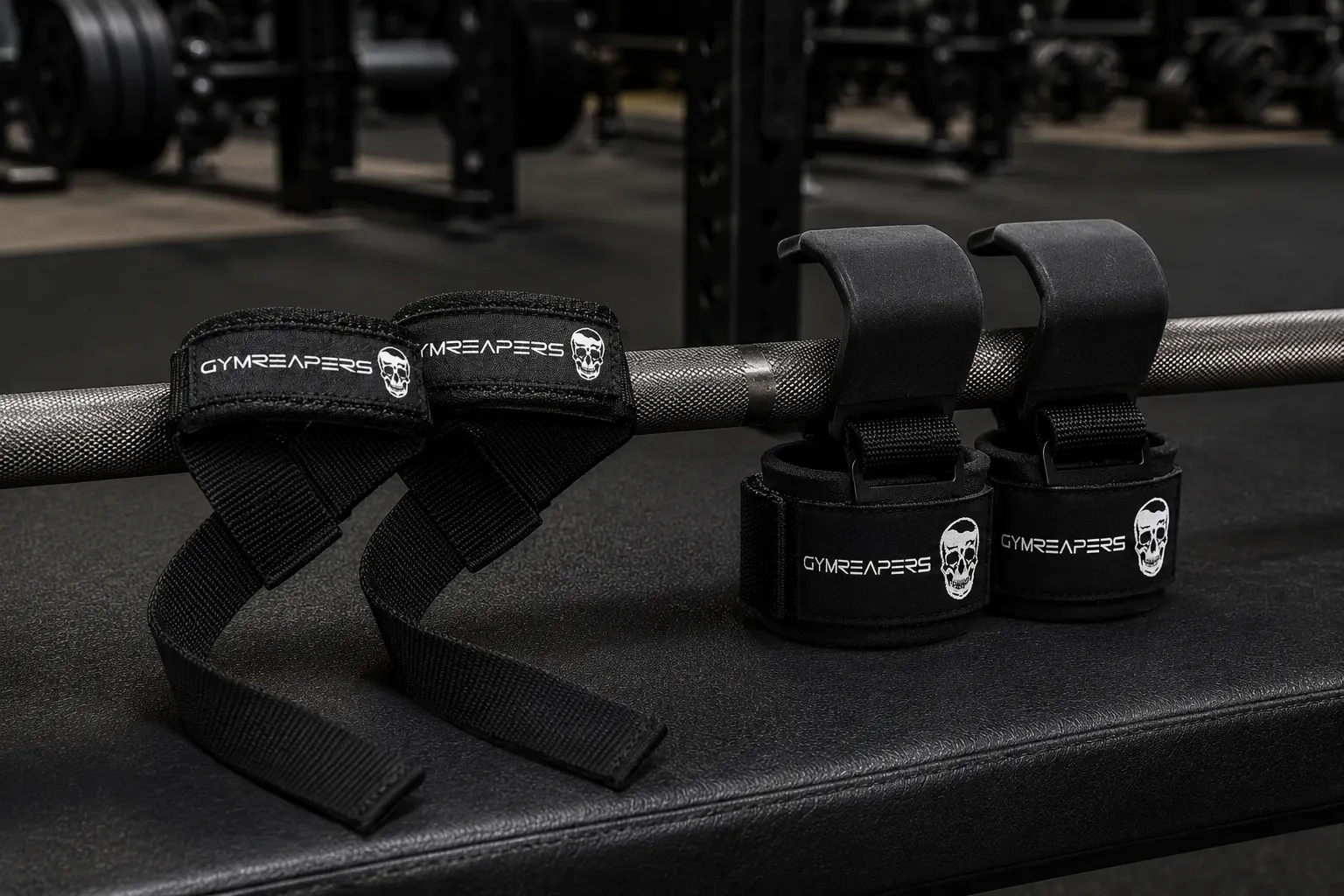
A lifting strap wraps around the bar and becomes part of your grip.
A lifting hook places a rigid hook between your hand and the bar.
That sounds like a small difference.
In use, it changes almost everything: setup speed, bar feel, versatility, and how much control you still have through your fingers.
For most lifters, straps are the more versatile tool.
Hooks make a strong case when convenience is the priority.
Table of Contents
The short version
Choose lifting straps if you want a compact tool that works with many bars and handles, keeps direct hand contact with the bar, and gives you more control over how tightly you connect yourself to the load.
Choose lifting hooks if you want very fast setup, less wrapping between sets, and strong grip assistance for rows, shrugs, RDLs, and similar pulls.
Gymreapers reaches a similar general conclusion in its current straps-versus-hooks guidance: straps require more practice but are more versatile, while hooks are quicker and more intuitive to attach to a bar.
| Lifting Straps | Lifting Hooks | |
|---|---|---|
| Setup | Takes practice | Very fast |
| Connection to bar | Strap wraps around bar | Rigid hook sits under bar |
| Hand contact | High | Reduced |
| Versatility | Higher | More dependent on bar or handle |
| Heavy deadlifts | Excellent use case | Depends more on exact hook model |
| Rows & shrugs | Excellent | Excellent |
| Gym-bag size | Tiny | Bulkier |
| Product load rating | Depends on material and construction | Check the exact hook rating |
| Best reason to choose | Versatility | Convenience |
Lifting straps still let you hold the bar
This is the biggest practical difference.
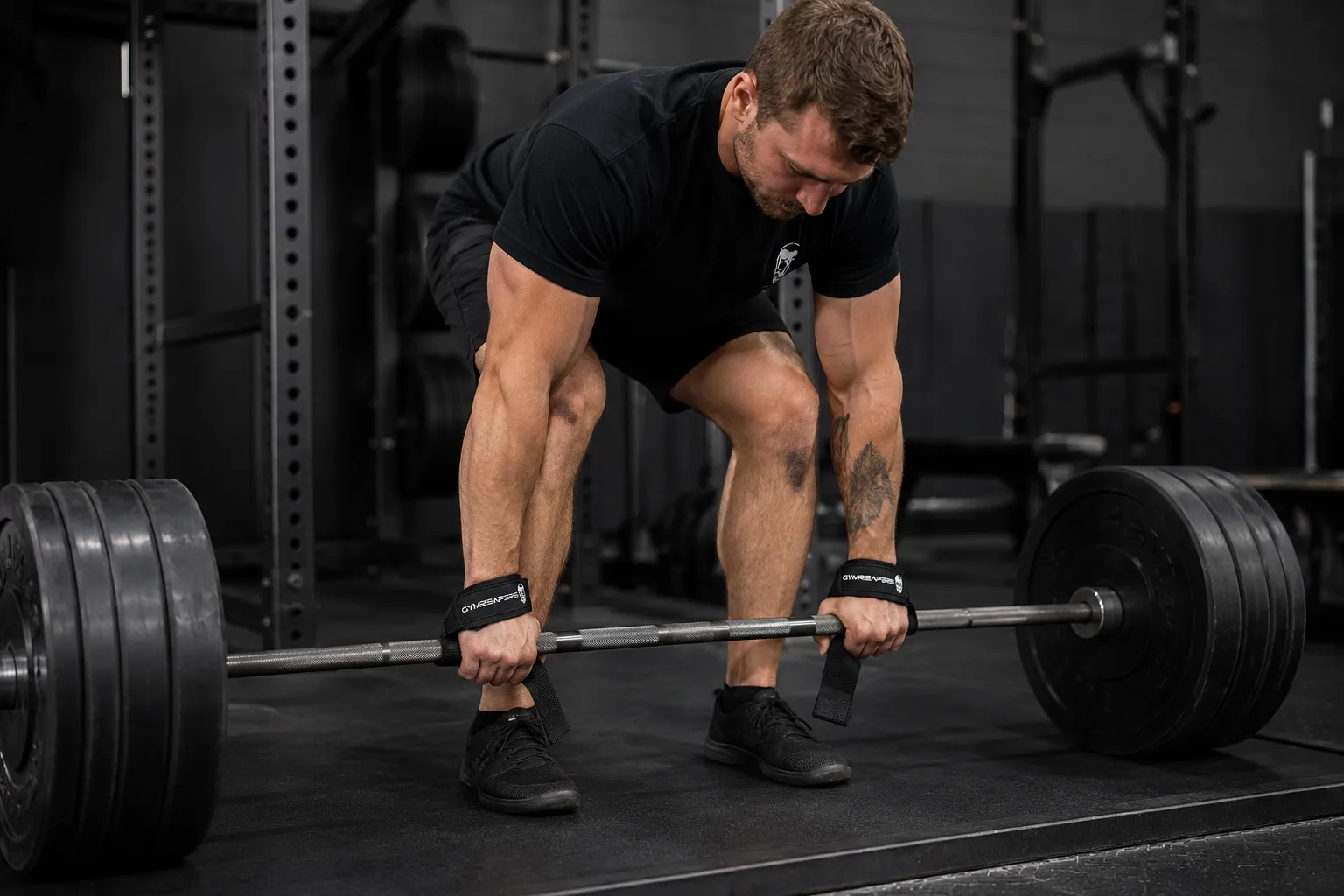
With traditional lasso-style straps, your hand still wraps around the bar normally.
The strap simply goes around the bar in the opposite direction and tightens as you rotate your hand into position.
That means you still feel the knurling, the diameter of the bar, where the bar sits in your palm, and how tightly you want to close your fingers.
The strap is assisting your grip rather than replacing the shape of the bar with a piece of hardware.
Gymreapers' current padded lifting straps use an 18-inch cotton strap with neoprene padding around the wrist and are intended for pulling work such as deadlifts, rows, and heavy back training.
Iron Bull's classic straps use the same general idea: a fabric strap wraps the bar while padded neoprene sits against the wrist.
That simple construction is one reason straps work for so many lifters.
A closer look at conventional lifting straps
We already have a separate Gymreapers Padded Lifting Straps review covering their construction and normal pulling use.
We also have an Iron Bull Strength Padded Lifting Straps review if you want another example of the traditional padded-strap design.
You can check the current Gymreapers straps page, view Gymreapers Lifting Straps on Amazon, or view Iron Bull Strength Lifting Straps on Amazon.
Hooks change the connection completely
A lifting hook works differently.
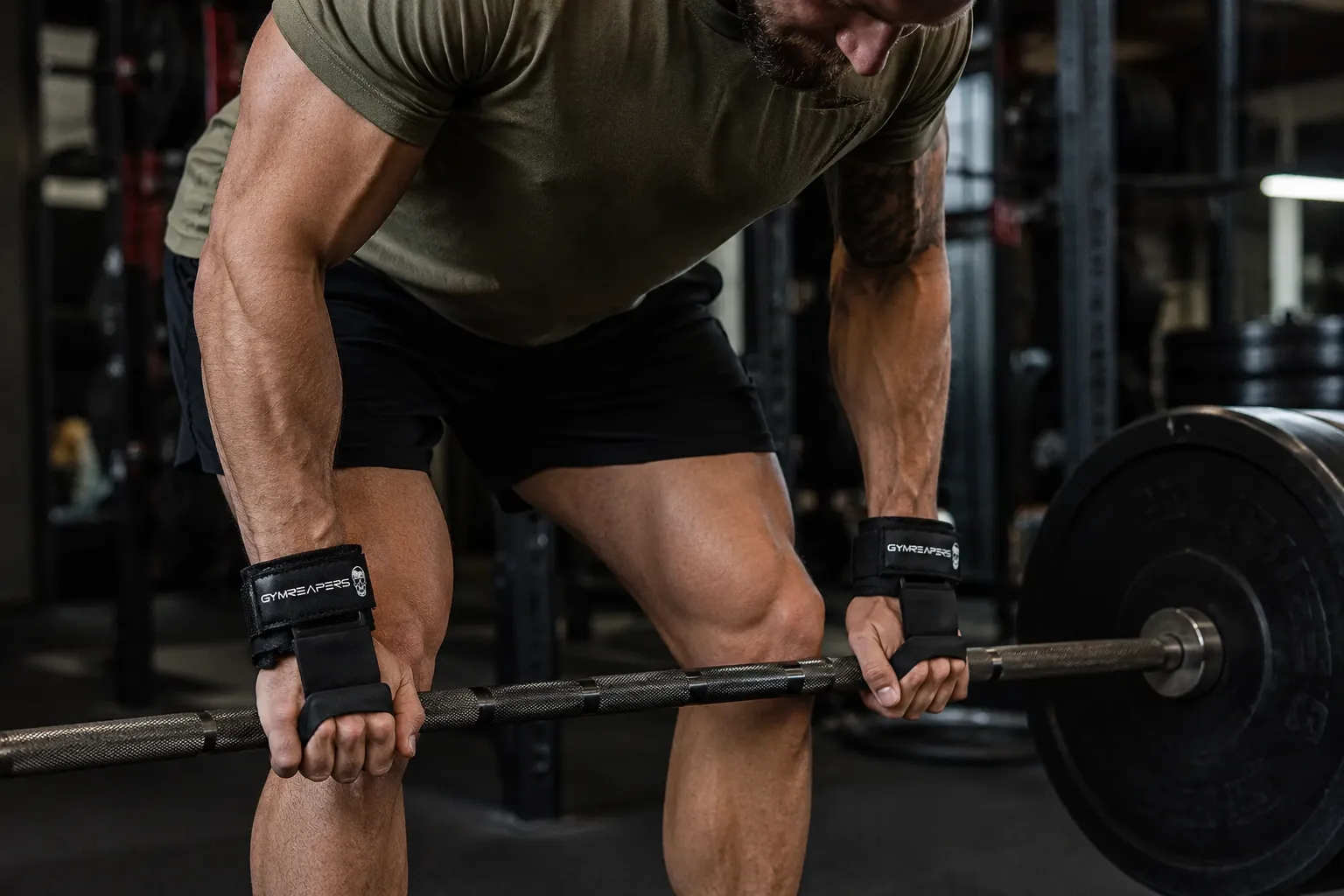
Instead of wrapping fabric several times around the bar, you secure a padded cuff around the wrist and place the rigid hook underneath whatever you are pulling.
Gymreapers' current lifting hooks use a coated metal hook attached to a neoprene-padded wrist section. The company positions them for deadlifts, rows, pull-ups, shrugs, and other pulling movements.
Iron Bull uses the same basic concept with a coated steel hook and padded wrist cuff.
The advantage becomes obvious the first time you use them.
Put the cuff on. Place the hooks under the bar. Grip. Pull.
For a bodybuilding session with several sets of rows and shrugs, that can be genuinely convenient.
Hooks are easier when you are tired
Straps are not difficult once you know how to use them.
But there is a learning curve.
The first few times, people often wrap in the wrong direction, leave too much loose material, get one side tighter than the other, or spend too much time trying to wrap the second hand after the first one is already attached to the bar.
Hooks mostly remove that problem.
This becomes useful late in a workout.
Imagine you have already done deadlifts, pulldowns, and several rowing sets. Now you want three heavy sets of shrugs.
Your forearms are tired. Your hands are tired. You are not interested in performing origami around the bar.
Hooks make a lot of sense there.
Gymreapers likewise identifies ease of use as one of their main advantages over traditional straps.
Our hook examples
We currently have two useful hook pages on the site: Gymreapers Weight Lifting Hooks and HWK Sports Weightlifting Hooks.
Those are better pages to visit if you are comparing specific hook constructions rather than deciding between hooks and straps in general.
You can also view Gymreapers Weight Lifting Hooks on Amazon or view HWK Sports Weightlifting Hooks on Amazon.
For deadlifts, I would usually start with straps
If you asked me to choose one of these specifically for heavy deadlift training, I would normally choose straps.
Not because hooks cannot be used for deadlifts. They can. Both Gymreapers and Iron Bull list deadlifts among the intended exercises for their current hooks.
The reason is flexibility.
With a strap, the fabric wraps around the bar you are actually holding. You decide how much material to use and how tight to cinch it, and there is no rigid hook whose dimensions need to match the bar particularly well.
That becomes increasingly useful as loads get heavier.
Hooks also have model-specific load ratings. That does not mean hooks as a category are weak. It means you cannot talk about “lifting hook capacity” as if every hook is the same.
Always check the exact product.
Rows and shrugs are where hooks become very attractive
For bodybuilding-style pulling, I think the decision is much closer.
Consider chest-supported rows. You are not trying to prove how strong your fingers are. You are trying to keep pulling with your back.
If your grip starts opening before your upper back is finished, grip assistance can let the set continue closer to the point where the intended muscles are actually limiting you.
Hooks are particularly convenient here because you can move between sets quickly.
The same logic can apply to barbell shrugs, dumbbell shrugs, some machine rows, RDLs, and certain cable pulls.
This is probably the strongest argument for hooks.
Not “they are stronger than straps.” They are simply easy to use repeatedly.
Straps work with more shapes
Bars are easy. Gym equipment is not always easy.
Some machines have thick handles. Some have narrow handles. Some cable attachments are round. Others are rubberized, angled, rotating, or oddly shaped.
A fabric strap can conform to many of those shapes.
A rigid hook has its own curvature.
If the handle fits nicely inside that curve, great. If it does not, the experience can be less natural.
This is another reason straps remain the more versatile option.
The bar feels different with hooks
This is difficult to appreciate until you try both systems.
With straps, your palm and fingers are still wrapped around the bar.
With hooks, some of the load is hanging through a rigid piece underneath it.
That can make hooks feel almost effortless for the grip.
For some lifters, that is exactly the point. For others, it feels too disconnected.
Iron Bull's current accessory guidance makes the same practical distinction: hooks provide greater grip relief, while straps retain more hand involvement.
Neither feel is inherently correct.
If you want to train your back while asking as little as possible from tired hands, hooks can be excellent.
If you still want the lift to feel like you are gripping the bar, straps are more natural.
Do straps weaken your grip?
Not automatically.
The more useful question is when you use them.
If you put straps on every warm-up set, every row, every deadlift, every pulldown, and never ask your hands to hold anything difficult, you are obviously doing less direct grip work.
That does not mean straps themselves weaken your grip.
It means you stopped training your grip.
If grip strength matters to you, keep some unassisted pulling in your program. Then add straps when grip becomes the thing preventing you from training the movement you actually care about.
The same applies to hooks
Hooks can remove even more grip demand than straps.
That makes them excellent for some hypertrophy work.
It also means that if grip development is part of the purpose of the exercise, hooks may defeat that particular purpose.
A heavy shrug done because you want to overload the traps? Hooks can make sense.
A loaded carry programmed specifically because you are trying to improve grip endurance? Maybe leave them in the bag.
The tool should follow the goal of the set.
Neither is “cheating” in normal training
Calling straps or hooks cheating in a gym session does not make much sense.
Training is not a standardized competition. You choose tools based on what you are trying to improve.
If the goal is back hypertrophy and grip is ending every set early, removing some grip limitation can be useful.
If the goal is grip strength, obviously you should not remove the grip challenge.
The distinction matters more in actual powerlifting competition.
The current IPF rulebook specifies permitted personal equipment such as belts, knee sleeves, and wrist wraps. Lifting straps and lifting hooks are not included as permitted platform equipment, so they should be treated as training accessories rather than IPF competition deadlift equipment.
That is normal. Plenty of useful training tools never go onto the competition platform.
What about wrist comfort?
Both systems transfer load toward the wrist, so cuff and padding design matter.
Gymreapers uses neoprene padding on both its traditional lifting straps and hooks, while Iron Bull also uses padded wrist sections on its current straps and hooks.
But padding does not guarantee identical comfort.
A strap tightens as the bar rotates against it. A hook places load through the hook assembly and wrist cuff.
Some people strongly prefer one pressure pattern over the other.
If you notice numbness, sharp pressure, or obvious circulation restriction, changing the setup is more sensible than simply tightening everything harder.
Which is easier to carry?
Straps. By a lot.
A pair of basic lifting straps can disappear into a side pocket of a gym bag.
Hooks have rigid hardware and take more room.
This is not a performance issue, but small practical details are often what determine whether you actually bring a piece of equipment with you every week.
So which should you buy first?
For most lifters, I would buy lifting straps first.
They are simple, compact, adaptable, and useful across a large range of pulling exercises.
Once you learn to wrap them properly, the setup stops feeling complicated.
Hooks become more attractive when you already know what annoys you about straps.
Maybe you hate wrapping the bar between every set. Maybe your hands are exhausted late in back day. Maybe you primarily want grip assistance for machine rows, shrugs, and controlled pulling work.
Then hooks solve a real problem instead of simply being a more complicated accessory.
Bottom Line
Lifting straps and hooks both help when grip is limiting a pulling exercise, but they do not feel the same.
Straps are the more versatile choice.
They wrap directly around the bar, keep your hand involved, work with a wide range of handles, and make especially good sense for heavy deadlift and rowing work.
Hooks are the convenience choice.
They attach quickly, remove much of the grip demand, and can be excellent for rows, shrugs, RDLs, and back sessions where your hands are failing long before the target muscles.
If you are buying one pair for the first time, start with straps.
If you already know you want faster setup and greater grip relief, hooks deserve a look.
And there is no reason you cannot own both.
Use the tool that matches the set.
FAQ
Are lifting straps better than lifting hooks?
For most lifters, straps are the more versatile option because they wrap around the bar and work with a wider variety of pulling movements and handles. Hooks are faster to set up and can provide greater grip relief.
Are lifting hooks good for deadlifts?
They can be. Current Gymreapers and Iron Bull hook models both list deadlifts among their intended uses. For very heavy pulling, check the exact hook design and manufacturer guidance rather than assuming all hooks are the same.
Are straps better for rows?
Both work well for rows. Straps retain more direct hand contact with the handle, while hooks are faster to attach and can remove more grip fatigue.
Do lifting straps stop grip development?
Not by themselves. But if you use grip assistance on every pulling set, you give your grip less work to do. Keep some unassisted training if grip strength is one of your goals.
Can I use lifting straps in a powerlifting meet?
Treat them as training equipment rather than IPF competition equipment. The current IPF personal-equipment rules specify permitted supportive items and do not include lifting straps or lifting hooks for platform use.
Which should a beginner buy?
Usually straps. They take a little practice to learn, but they are compact, versatile, and useful across a broad range of pulling exercises.
Sources for this article
- Gymreapers — Lifting Straps vs Hooks: current manufacturer comparison of setup, versatility, bar connection, and common use cases.
- Gymreapers — Padded Lifting Straps: current strap construction, padding, and intended pulling use.
- Gymreapers — Weight Lifting Hooks: current hook construction, padding, and intended exercises.
- Iron Bull Strength — Padded Lifting Straps: current padded strap design and pulling applications.
- Iron Bull Strength — Lifting Hooks: current hook construction, dimensions, wrist padding, and pulling uses.
- Iron Bull Strength — Lifting Accessory Guidance: current distinction between greater grip relief from hooks and continued hand involvement with straps.
- International Powerlifting Federation — 2026 Technical Rules: current competition equipment rules.
- Powerlifting-Gear.pro — Gymreapers Padded Lifting Straps Review.
- Powerlifting-Gear.pro — Gymreapers Weight Lifting Hooks Review.
- Powerlifting-Gear.pro — Iron Bull Strength Padded Lifting Straps Review.
- Powerlifting-Gear.pro — HWK Sports Weightlifting Hooks Review.