
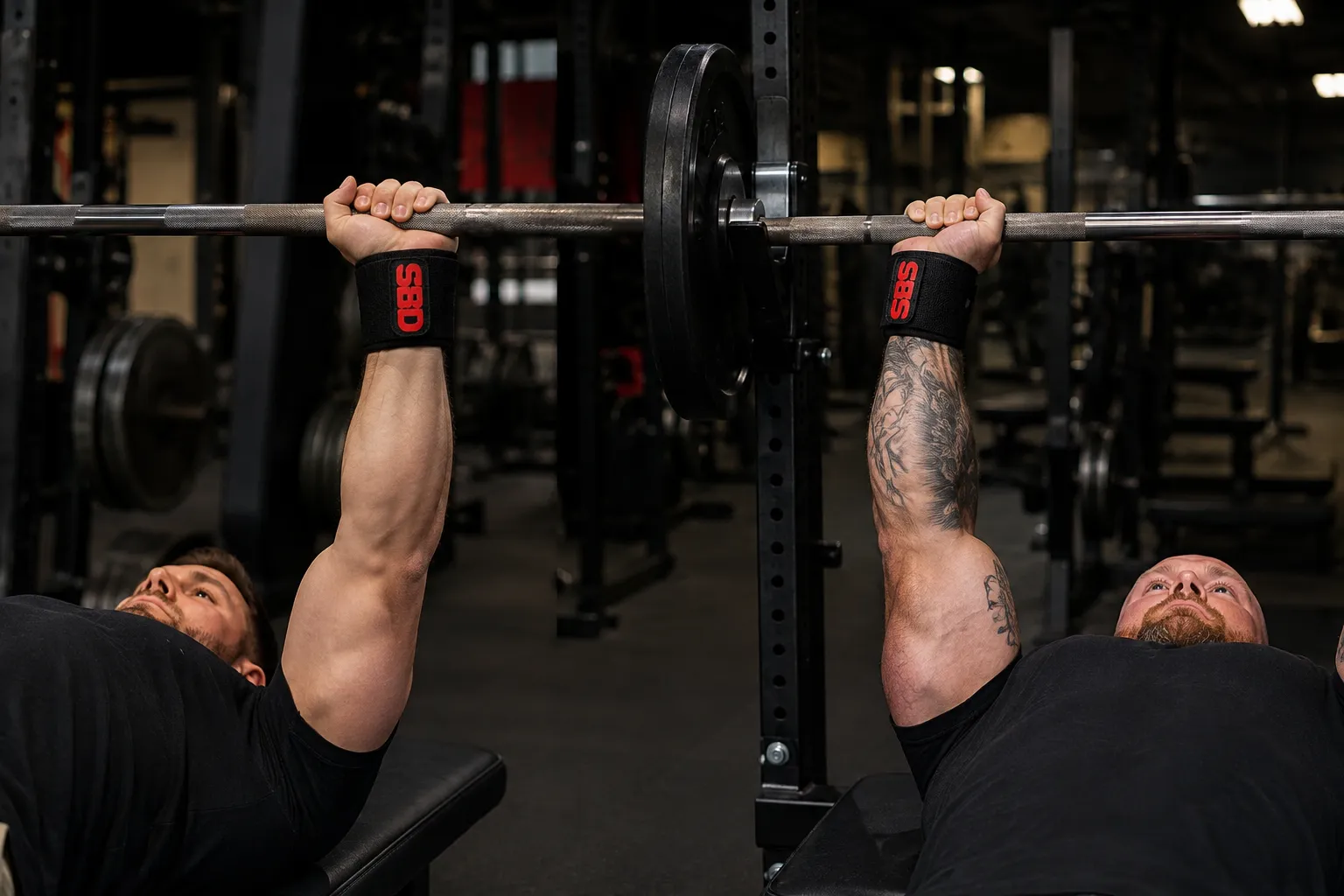
Flexible vs Stiff Wrist Wraps: Which Type Fits Your Lifting?
Stiff wrist wraps look like the obvious choice if you lift heavy.
They resist movement more. They feel more substantial. And in powerlifting, “more rigid” has a way of sounding automatically better.
It is not that simple.
A stiff wrap is useful when the goal is to keep the wrist from moving very much at all.
A flexible wrap still limits unwanted movement, but it molds around the wrist more easily and lets you keep some natural flexion.
That difference matters during an actual training week.
A wrap you love for a heavy bench single may feel unnecessarily restrictive during volume work, overhead pressing, front squats, or a session where you keep the wraps on for several exercises.
So the useful question is not:
Which wrap gives more support?
It is:
How much wrist movement do you actually want to keep?
Table of Contents
The short version
For most lifters, I would start with flexible wrist wraps.
SBD's current guidance says most athletes prefer a medium-length flexible wrap because it works across a broad range of exercises.
Choose stiff wraps when your priority is a much more fixed wrist position, particularly for heavy pressing where you deliberately want to resist wrist extension as much as possible. SBD describes its stiff version as being designed to immobilize the wrist and resist flexion, while the flexible version is designed to support the wrist while still allowing some movement.
| Flexible Wraps | Stiff Wraps | |
|---|---|---|
| Wrist movement | Some movement remains | Strongly restricted |
| Comfort | Usually easier for longer sessions | More demanding |
| General training | More versatile | More specialized |
| Heavy bench | Very usable | Stronger case |
| Overhead work | Often easier | Can feel restrictive |
| First pair | Usually easier choice | Better if you know you want rigidity |
| Adjustment through the session | Easier to vary | More sensitive to wrapping tension |
The important word there is specialized.
Stiff does not mean superior.
It means more resistant to movement.
What flexible wraps actually do
“Flexible” does not mean loose.
A good flexible wrist wrap can still be pulled tight enough to create a very secure feel around the wrist.
The difference is in what happens after it is wrapped.
SBD says its flexible wraps are designed to mold around the wrist while still allowing supported wrist flexion.
That makes them easier to use when the workout is not built around one heavy press.
Imagine:
- bench press;
- incline dumbbell work;
- overhead press;
- rows;
- then accessories.
You may want some extra structure around the wrist for the heavy sets without feeling as though the joint has been put in a cast for the next hour.
That is where flexible wraps make sense.
They can still be tightened aggressively for a top set.
Then you can loosen the next wrap slightly for volume.
The equipment adapts to the session instead of dictating the session.
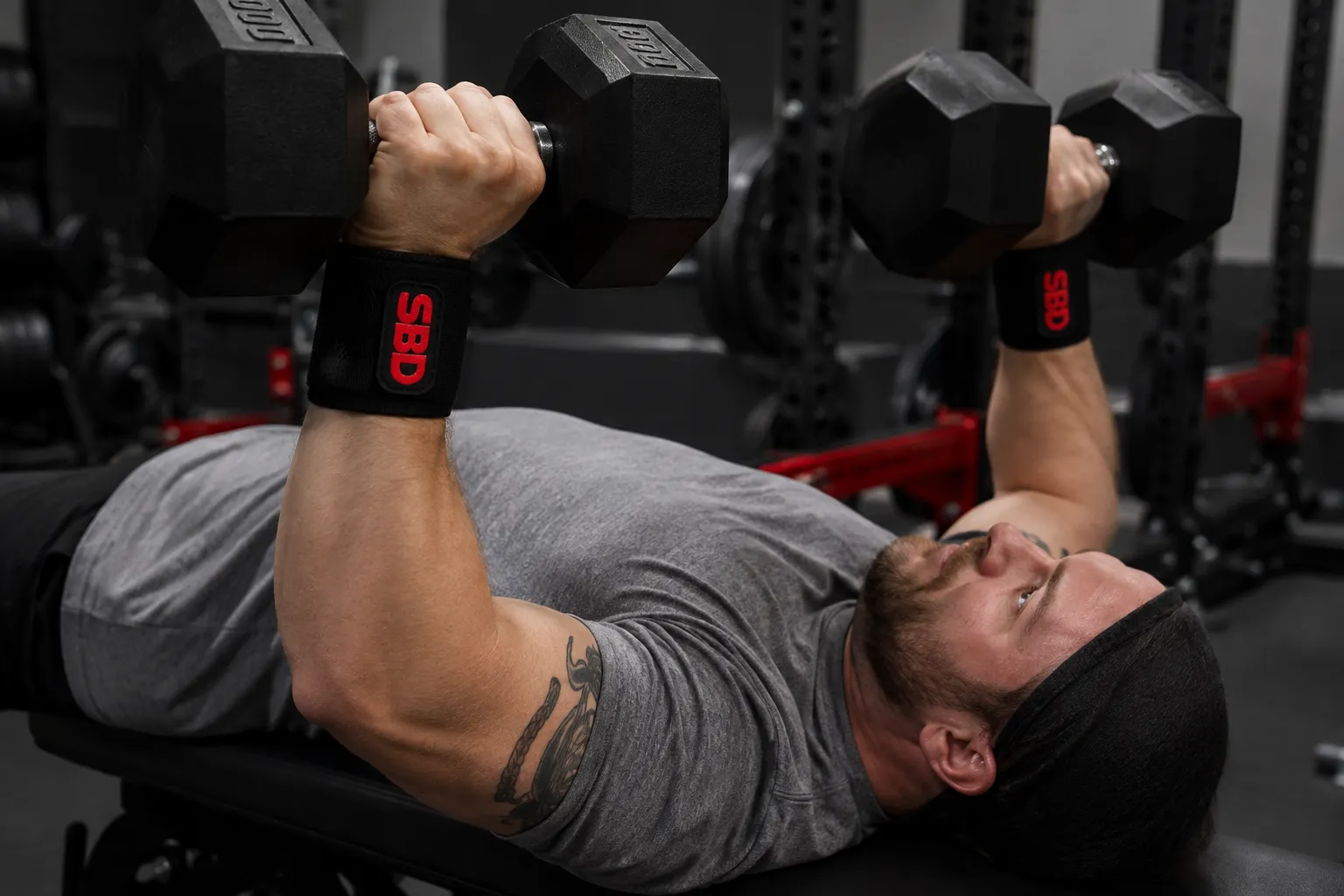
Stiff wraps have a clearer job
A stiff wrap is much less subtle.
Its job is to resist wrist movement.
SBD describes the stiff version as designed to “cast and immobilize” the wrist and resist wrist flexion.
That becomes attractive when you are benching heavy and the bar wants to push the hand backward.
If your preferred setup is a very straight, fixed wrist under heavy pressing, a stiff wrap gives you more resistance against that movement.
That does not mean it fixes poor bar position.
And it does not mean everybody benching heavy needs the stiffest wrap available.
Some lifters hate the feeling.
Others would not bench without it.
The advantage only exists if the rigidity matches the setup you want.
Bench press is where stiffness matters most
The bench press is probably the easiest place to understand the difference.
As the load increases, the wrist can extend backward under the bar.
Wrist wraps are commonly used to create a more stable wrapped position for pressing, and SBD specifically describes its current wraps as being developed for wrist support with flexible and stiff versions for different levels of allowed movement.
With a flexible wrap, you still have a little freedom to settle into your preferred hand position.
With a stiff wrap, you can create a more fixed structure.
For a heavy single, that may be exactly what you want.
For five sets of eight, maybe not.
This is why I would not choose stiffness based only on your one-rep max.
Think about how much of your training happens below your max.
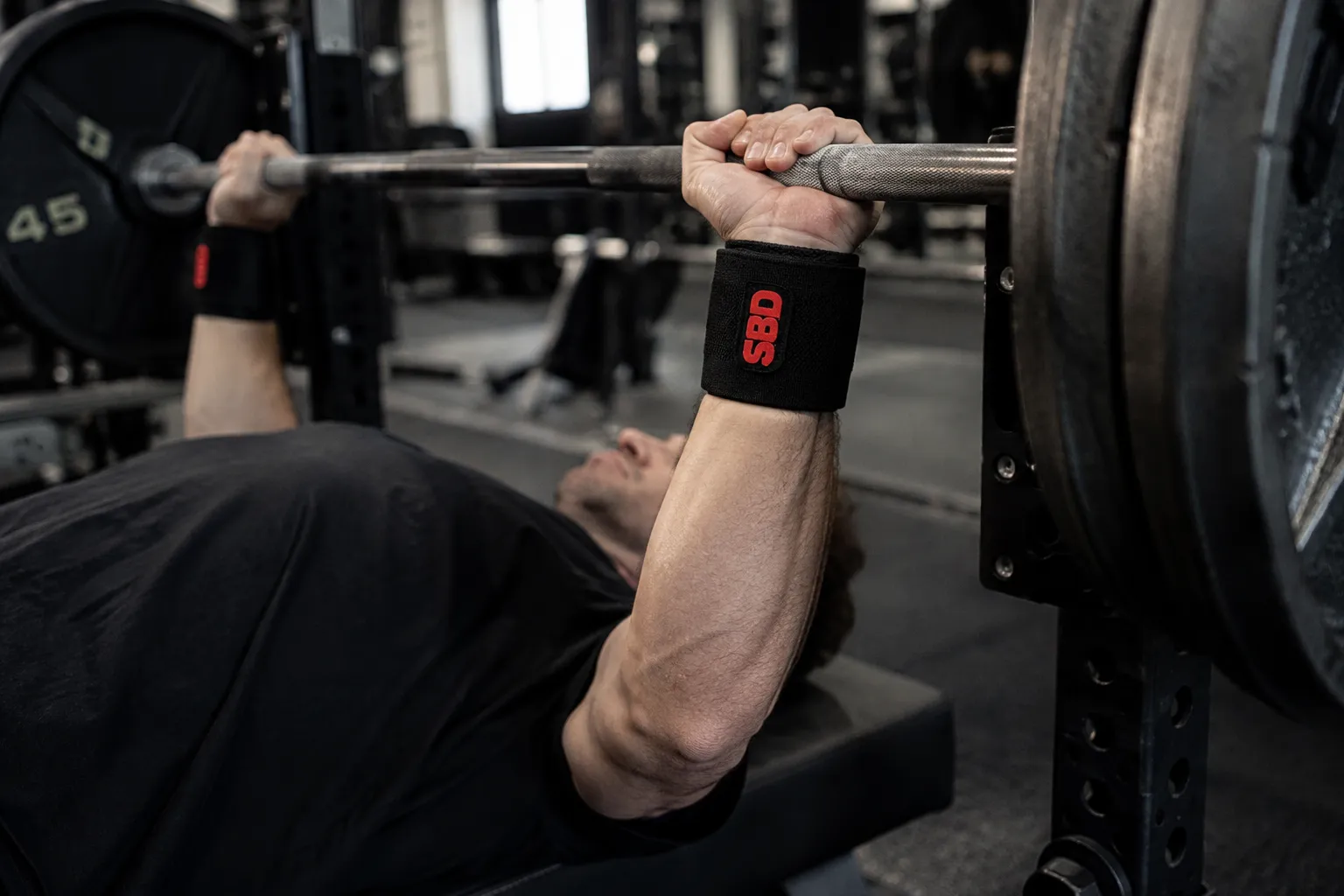
Overhead pressing can feel different
Overhead work often exposes whether a wrap is more restrictive than you actually need.
Some lifters like a very fixed wrist for strict pressing.
Others want a little more freedom as the bar moves through the press.
Gymreapers makes a similar distinction in its current flexible-versus-stiff guidance: it positions stiff wraps more toward heavy pressing and powerlifting, while flexible wraps make more sense when the athlete wants a greater range of motion.
Neither setup is universally correct.
If your wrists feel comfortable and controlled with a flexible wrap, there is no prize for making the wrap harder to move.
Length matters almost as much as stiffness
This is where wrist-wrap shopping gets more interesting.
You are not only choosing flexible versus stiff.
You are also choosing how much material goes around the wrist.
SBD currently offers:
- Small — 40cm / 15.7in
- Medium — 60cm / 23.6in
- Large — 100cm / 39.4in
That changes the feel considerably.
A longer wrap gives you more material and more turns around the wrist.
A shorter wrap is faster to put on and creates less bulk.
SBD calls the medium size the standard option for medium-to-large wrists and identifies the large 100cm version as the maximum competitive length in its range.
This means a large flexible wrap can sometimes give you more usable support than a short stiff wrap, depending on how tightly and how many times you wrap it.
Stiffness and length work together.
Do not shop for them as if they are unrelated.
Medium flexible is a very sensible starting point
If somebody asked me which SBD configuration to try first without giving me any other information, I would start with:
Medium + Flexible.
That is also the configuration closest to SBD's own general recommendation: the company says most athletes prefer a medium-length flexible wrap for a variety of exercises.
It gives you enough length to build meaningful tension without immediately moving into the bulk of a full 100cm wrap.
And because it is flexible, you can learn how much tension you actually like.
That matters if this is your first serious pair.
You may discover that you do not need the stiff version at all.
A closer look at the SBD flexible version
We already have a separate SBD Flexible Wrist Wraps review covering the SBD construction, lengths, fit, and normal training use in more detail.
For this comparison, the important thing is simply where that product sits: it is the more versatile side of SBD's wrist-wrap lineup.
You can also check the current SBD wrist-wrap page or view SBD Flexible Wrist Wraps on Amazon.
Large flexible wraps are more adjustable than they look
The 100cm flexible version deserves its own mention.
SBD specifically says the large flexible wrap can be altered to feel more or less supportive depending on how many times it is wrapped around the wrist.
That gives experienced lifters quite a bit of control.
Wrap it tighter and use more of the length for a heavy bench set.
Use less tension when you want more movement.
The trade-off is obvious: 100cm is a lot of material.
If you hate wrapping and unwrapping equipment between sets, the large version may be more annoying than helpful.
More length gives you options.
It also gives you more wrap to deal with.
Stiff does not mean “for advanced lifters only”
This is another distinction worth cleaning up.
A newer lifter is physically capable of using stiff wrist wraps.
An experienced lifter is physically capable of preferring flexible ones.
The useful difference is preference and training purpose, not status.
Stiff wraps make sense when somebody has already decided:
I want my wrist movement restricted more strongly.
If you do not know whether you want that, flexible wraps are easier to learn with because you can experiment with tension without immediately committing to the most rigid setup.
That is a product-choice issue, not an experience badge.
Do not wrap them as tight as physically possible
A wrist wrap is not better simply because your hand starts tingling.
Iron Bull's current wrist-wrap guidance warns against excessive tightness that restricts circulation and causes discomfort.
The wrap should create the amount of resistance you want without making the hand numb or discolored.
If you need maximum tension for a heavy set, you can tighten it before the attempt and loosen it afterward.
There is no reason to walk around the gym for twenty minutes with an aggressively wrapped wrist just because the set is finished.
Wrist wraps are not treatment for wrist pain
This is another area where lifting-equipment marketing can get ahead of itself.
Wrist wraps can change how much the wrist moves under load.
They can make a pressing setup feel more stable.
That does not tell you why a wrist hurts.
If pressing suddenly causes sharp or persistent pain, buying a stiffer wrap is not the same thing as figuring out the cause.
Use wraps as lifting equipment.
That is enough.
What about competition?
SBD currently lists both flexible and stiff wrist wraps as IPF approved, as well as USAPL and USPA compliant. The brand specifies a maximum width of 8cm and offers the large version at 1m, the maximum competition length.
The current IPF Approved List is valid through December 31, 2026 and applies to approved apparel and supportive equipment used at IPF-sanctioned competitions.
As with belts and knee sleeves, do not assume that every wrist wrap sold online is automatically meet legal just because its dimensions look right.
Check the exact model and federation before competition.
So which should you choose?
Choose flexible wrist wraps if:
- you want one pair for several types of training;
- you bench but also overhead press and do general strength work;
- you prefer some natural wrist movement;
- this is your first serious pair of wraps;
- you want to adjust support mainly through wrapping tension.
Choose stiff wrist wraps if:
- heavy benching is the main reason you are buying them;
- you specifically want to resist wrist extension more aggressively;
- you dislike wrist movement under heavy pressing;
- you already know that a flexible wrap feels too forgiving.
And do not forget length.
A medium flexible wrap and a large flexible wrap can feel surprisingly different.
A large stiff wrap and a small stiff wrap are not the same experience either.
Bottom Line
For most lifters, flexible wrist wraps are the easier starting point.
They provide useful support without forcing the wrist into the most rigid possible setup, and they are easier to use across different exercises.
Stiff wraps are more specialized.
They make sense when the goal is deliberately restricting wrist movement during heavy pressing.
Neither type is automatically better.
And the choice does not have to match how strong you are.
Think about three things:
How much movement do you want?
How long a wrap do you want to manage?
What lifts will you actually wear them for?
Answer those, and flexible versus stiff becomes a much easier decision.
FAQ
Are stiff wrist wraps better for bench press?
They can be a better fit for lifters who specifically want to limit wrist movement during heavy benching. SBD describes its stiff wraps as designed to resist wrist flexion, while flexible wraps intentionally allow some movement.
Are flexible wrist wraps still supportive?
Yes. Flexible does not mean loose. SBD's flexible wraps are specifically designed for wrist support while allowing some wrist flexion and closer molding around the joint.
What wrist-wrap length should I choose?
SBD currently offers 40cm, 60cm, and 100cm versions. Its own guidance says most athletes prefer a medium-length flexible wrap, while small suits smaller wrists and large provides more adjustment through additional wrapping.
Is 100cm too long?
Not necessarily. SBD uses 100cm for its large size and describes it as the maximum competition length. It gives more wrapping options but also creates more bulk and takes longer to apply.
Should wrist wraps be painfully tight?
No. They should provide the amount of restriction you need without excessive tightness, numbness, or circulation problems.
Are SBD wrist wraps IPF approved?
SBD currently lists its flexible and stiff wrist wraps as IPF approved, and the current IPF approved-equipment cycle remains valid through December 31, 2026. Competitors should verify the current list before a meet.
Sources for this article
- SBD Apparel — Wrist Wraps — current flexible/stiff construction, lengths, width, and competition information.
- SBD Apparel — Wrist Wrap How to Choose — current guidance for flexible/stiff choice and wrap length.
- International Powerlifting Federation — Approved Equipment List 2023–2026 — current approved-equipment reference.
- Gymreapers — Stiff vs Flexible Wrist Wraps — manufacturer comparison of movement, stiffness, and common training use cases.
- Iron Bull Strength — Wrist Wrap Guidance — guidance on wrist-wrap use and avoiding excessive tightness.
- Powerlifting-Gear.pro — SBD Flexible Wrist Wraps Review.
- Amazon — SBD Flexible Wrist Wraps.